
A full mock assessment centre, scored the way an assessor would.

Case study, competency interview and presentation, with an in-tray and a group exercise if you want them. One structured session, one final report, scored across every competency.

How it works

One session. Up to five stages. One report.

Stage 1 · ~12 minutes

Case study analysis

Read a realistic business scenario, then write a structured response under a timer. Tests how you analyse, prioritise and communicate under pressure.

  • Industry-specific scenarios
  • Timed response window
  • Structure and reasoning scored
Stage 2 · ~15 minutes

Competency interview

Five tailored competency questions with natural audio. Voice delivery, camera presence and answer quality all scored. Same engine as the interview practice product.

  • Tailored to your role and level
  • Voice and camera presence reviewed
  • Model answer per question

Stage 3 · ~5 minutes

Presentation simulation

Given a brief, record a 3-minute spoken presentation. The AI assesses structure, persuasion, pace and presence, the same things a real assessor watches for.

  • Realistic 3-minute time pressure
  • Spoken delivery scored
  • Structure and persuasion feedback

Stage 4, if you add it · ~30 minutes

In-tray exercise

A busy Monday inbox for your role: eight emails, documents and meeting requests. Decide what to do with each one, in what order, and write a short reply or note.

  • Written for your role and sector
  • Prioritising, judgement and delegation scored
  • Feedback item by item

Stage 5, if you add it · ~12 minutes

Group exercise

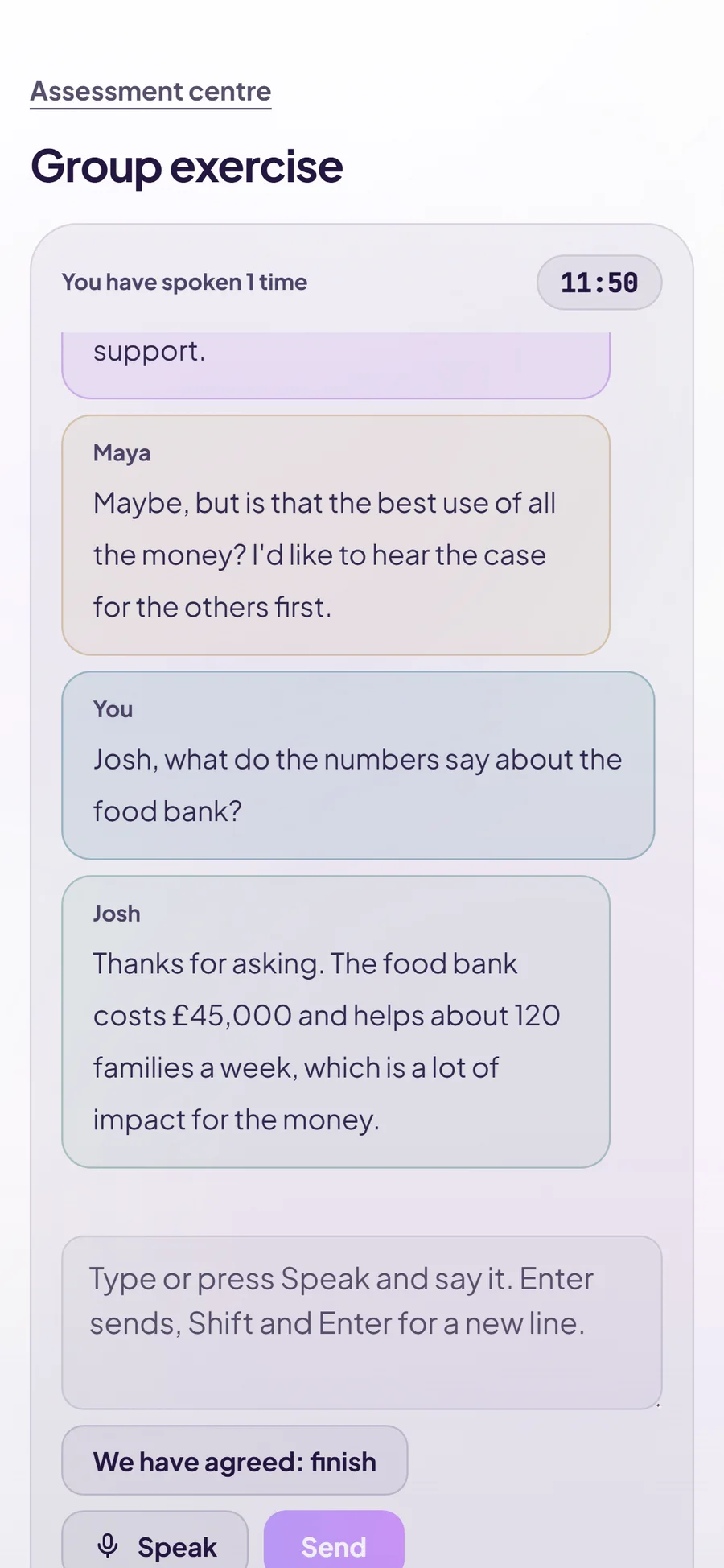
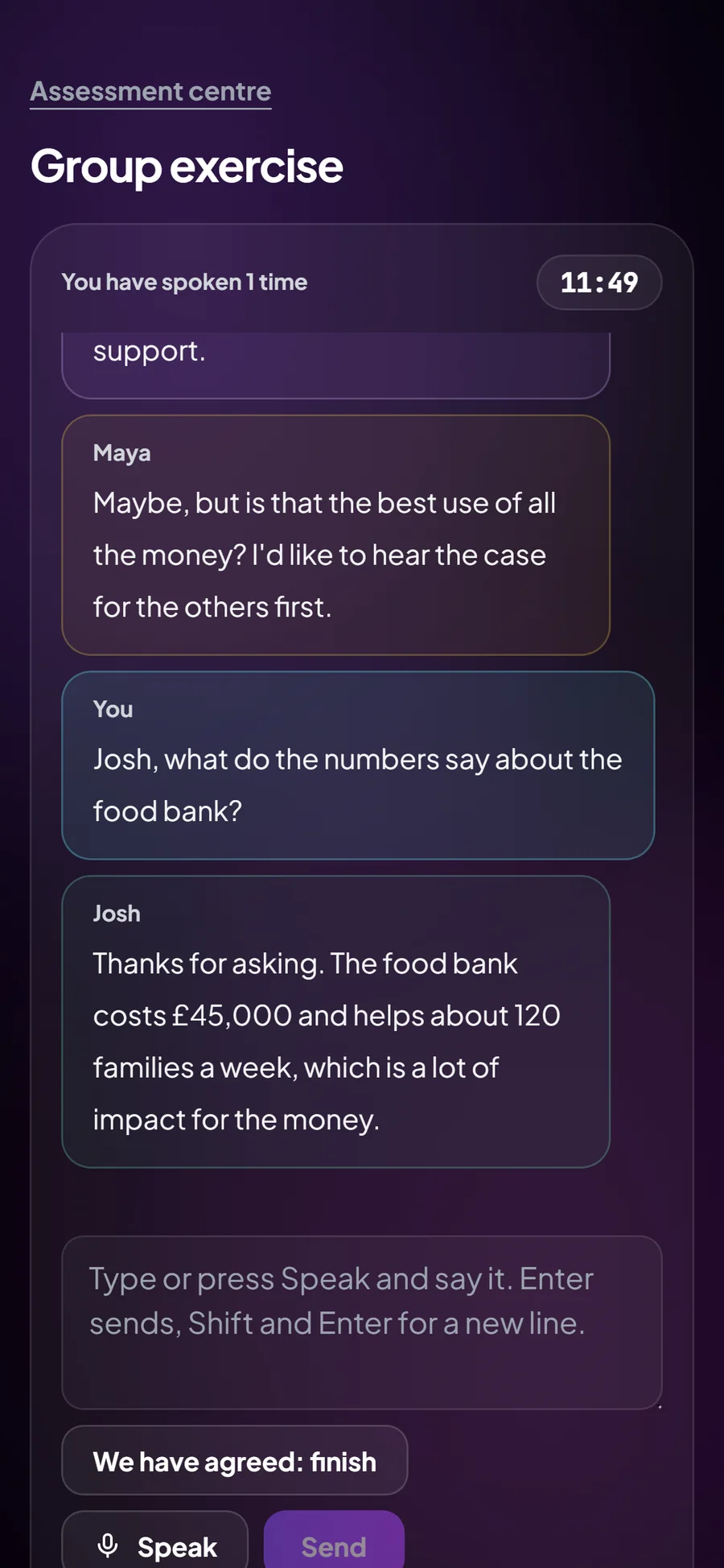
Agree a recommendation with three other candidates who each back a different option. Assessors watch how you contribute and bring the group to a decision, not whose idea wins.

  • 18 briefs across 13 career areas
  • Type or speak your contributions
  • Marked on contribution, listening and influence

See it

Every exercise, as you will see it

Real screens from a mock assessment centre, from the case study to the report at the end.

Stage 1: case study

Read the brief, then write your recommendation

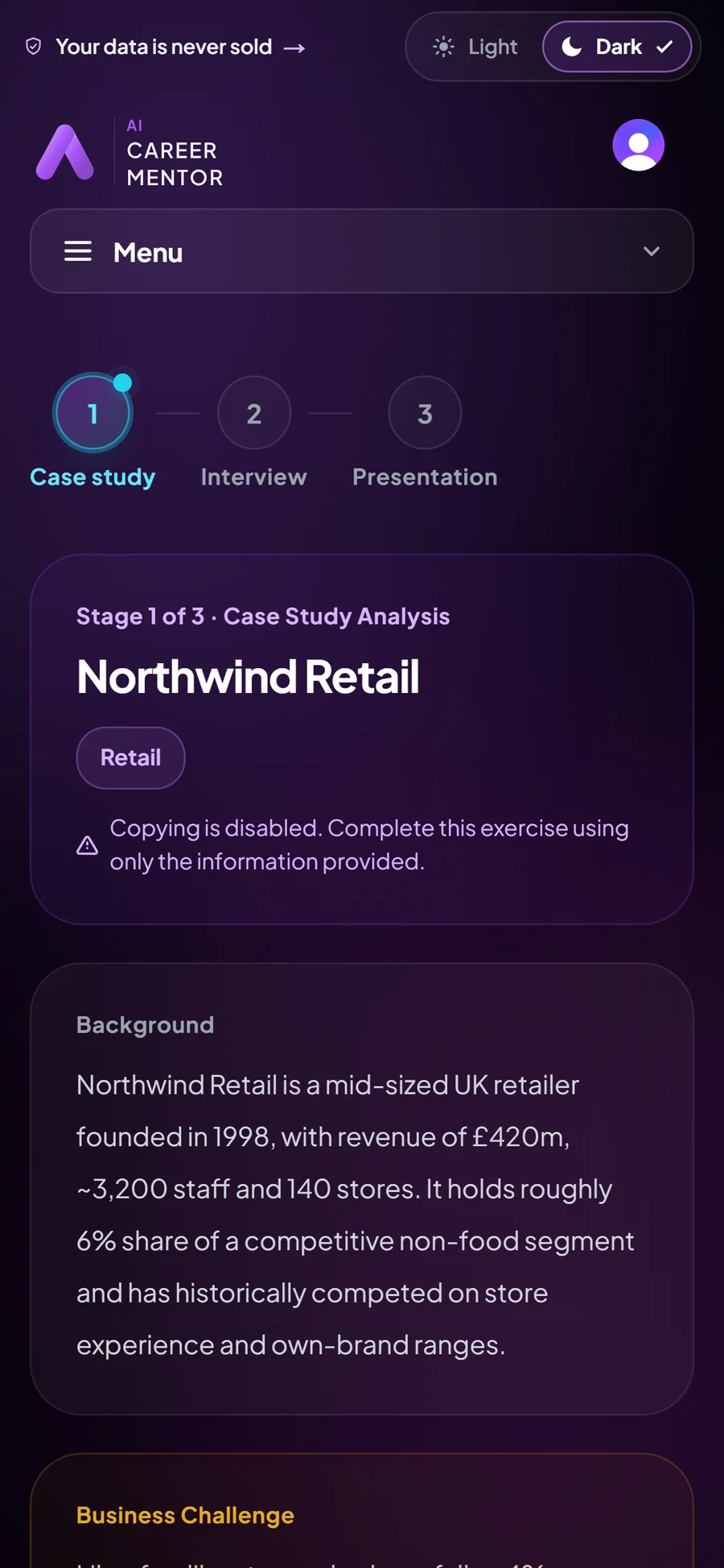
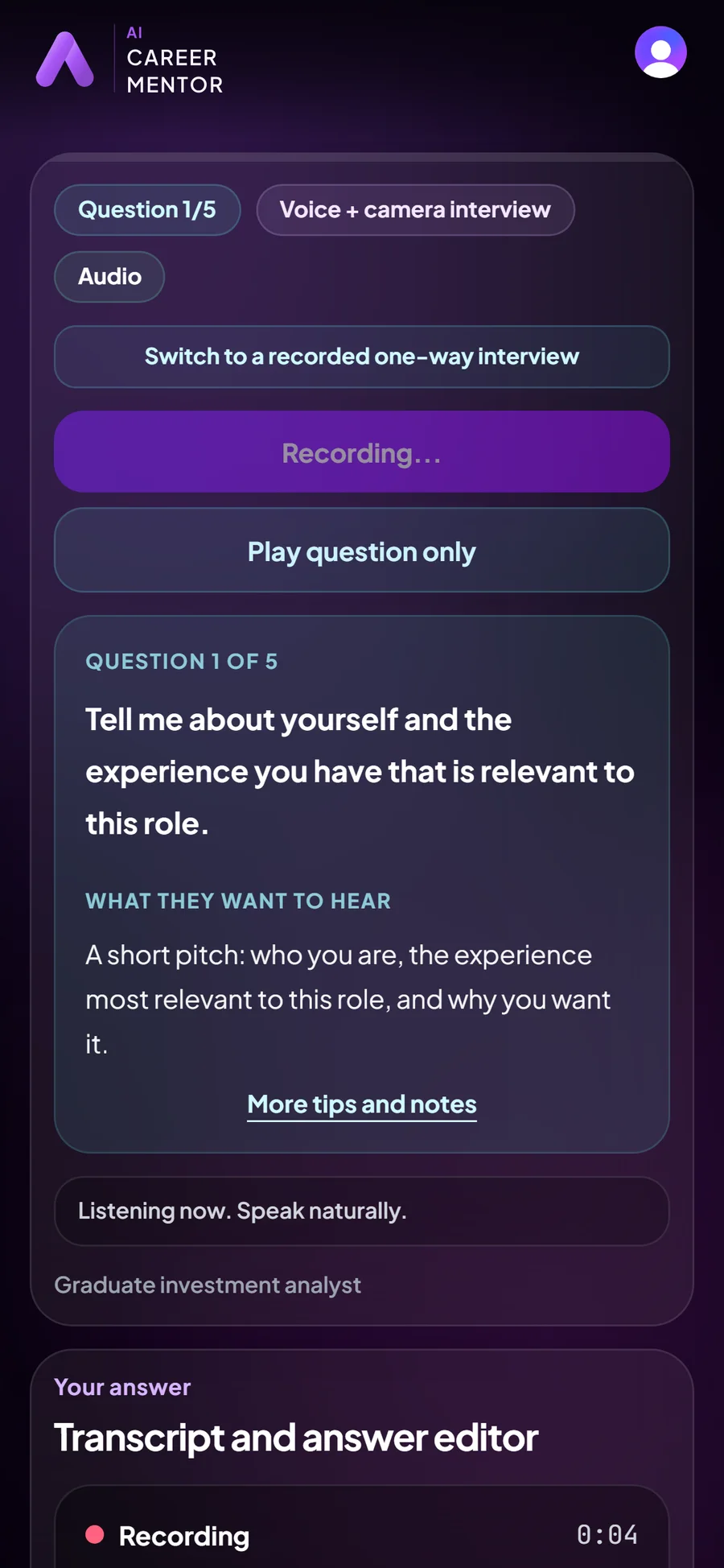
A realistic business case with exhibits to work from, and a clock running while you write.

  • A company, a challenge and the figures to back your answer
  • Timed, with pasting switched off, as on the day
  • Marked on analysis, judgement and how clearly you make the case
Case study stage: the Northwind Retail brief and figures beside a timed answer box with a written recommendationCase study stage: the Northwind Retail brief and figures beside a timed answer box with a written recommendation

Stage 2: competency interview

Answer the panel, with your camera on

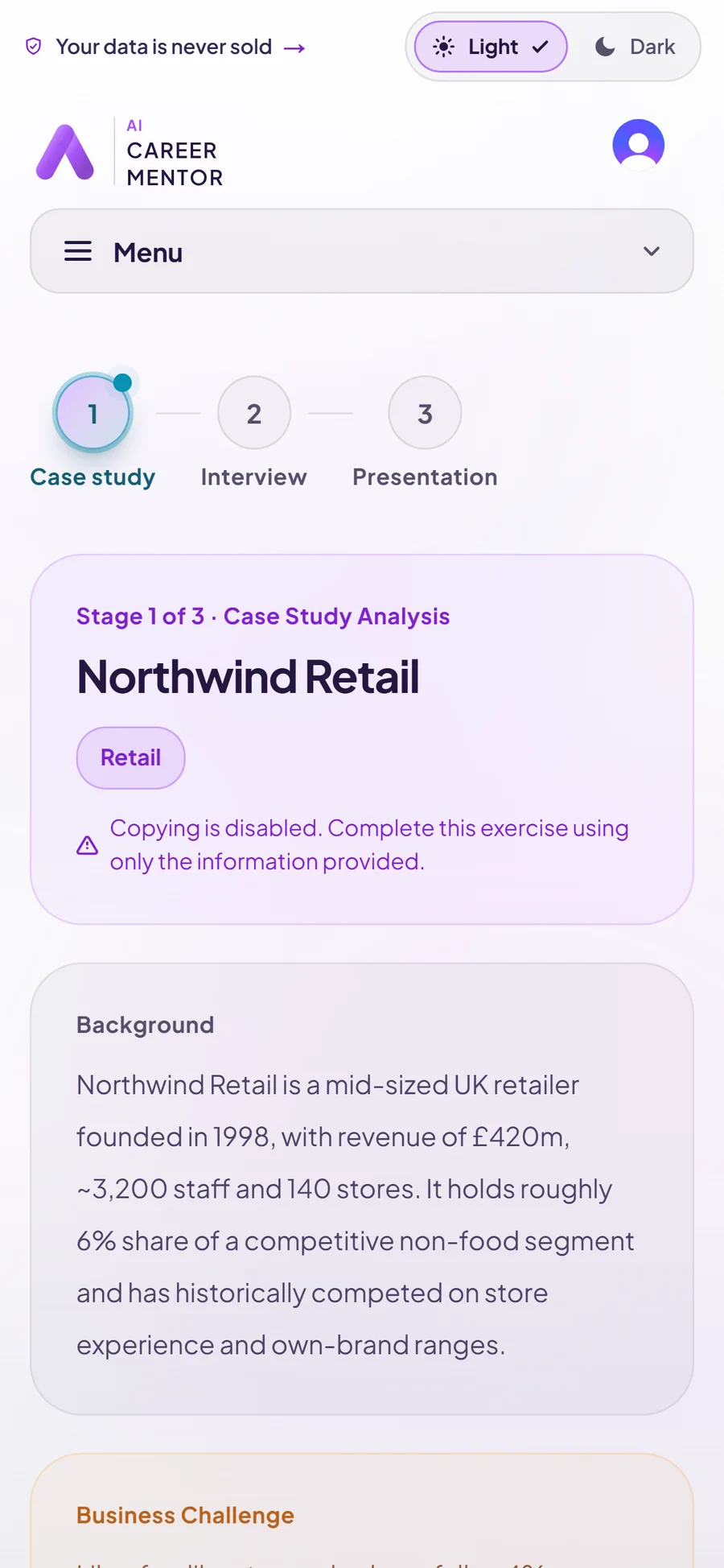
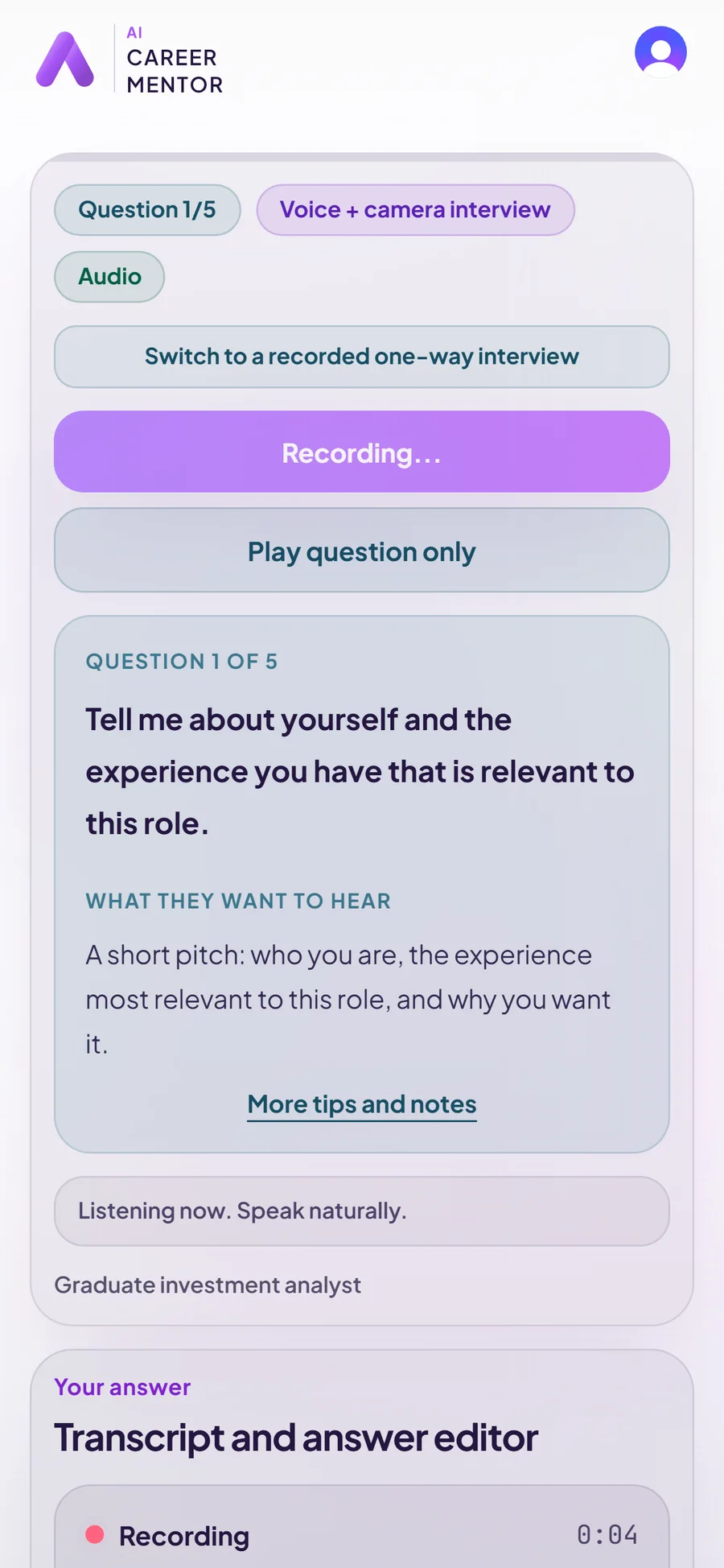
Five competency questions, read aloud, from the same interviewer as interview practice.

  • Spoken answers, with voice and camera presence scored
  • Follow-up questions when an answer leaves a gap
  • A model answer for every question
Assessment centre interview: question 1 of 5 on screen, the answer being recorded and the candidate's camera viewAssessment centre interview: question 1 of 5 on screen, the answer being recorded and the candidate's camera view

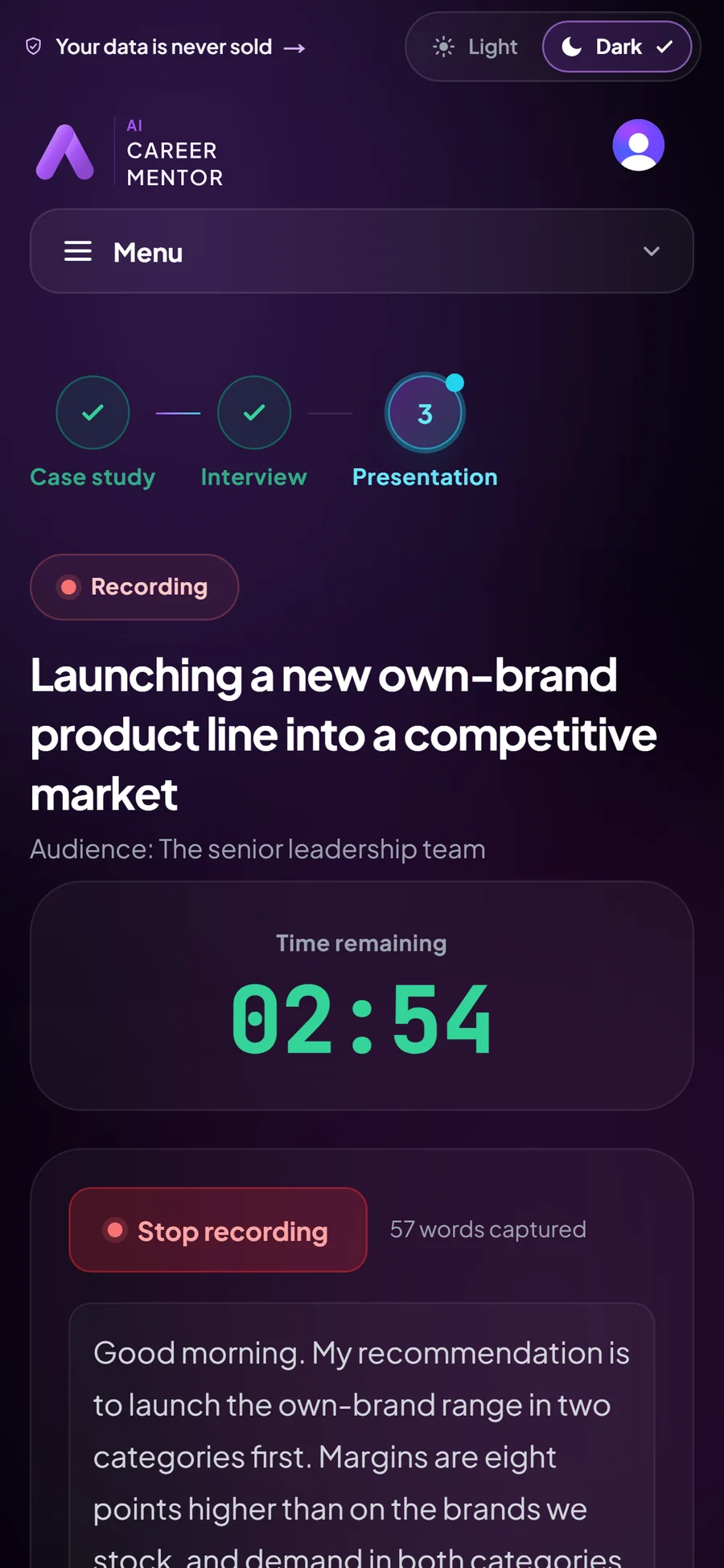
Stage 3: presentation

Present to the leadership team

A brief to prepare, then three minutes to present it, spoken, against the clock.

  • Preparation time, then the presentation starts on its own
  • Your words captured as you speak
  • Marked on structure, persuasion, pace and presence
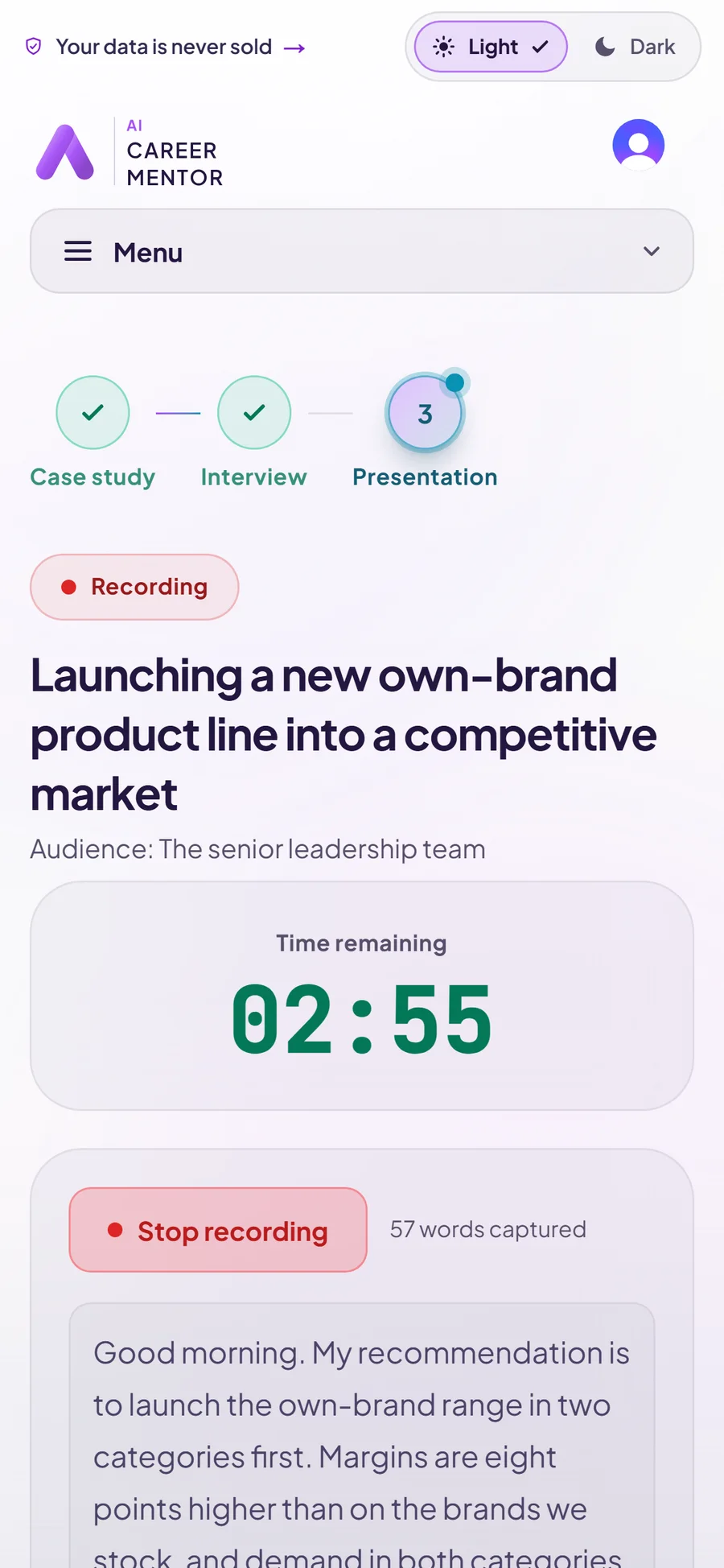
Presentation stage: recording, 2:55 left, with the spoken presentation appearing as textPresentation stage: recording, 2:55 left, with the spoken presentation appearing as text

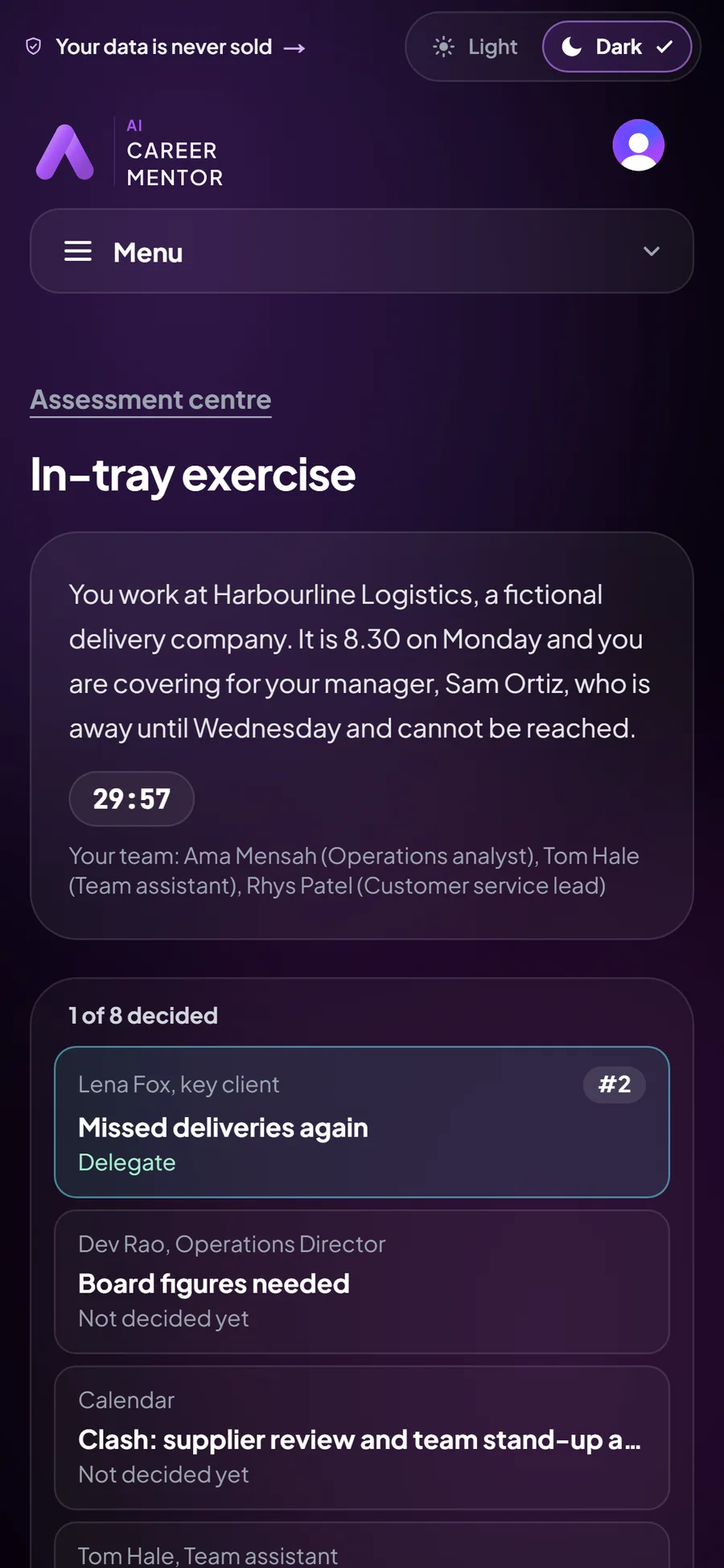
If you add it: in-tray

Clear a Monday-morning inbox

Eight emails, documents and meeting requests for your role. Decide what to do with each, in what order, and write the reply.

  • Deal with it now, delegate, schedule or leave it
  • Put them in order, and say who does what and why
  • Feedback item by item
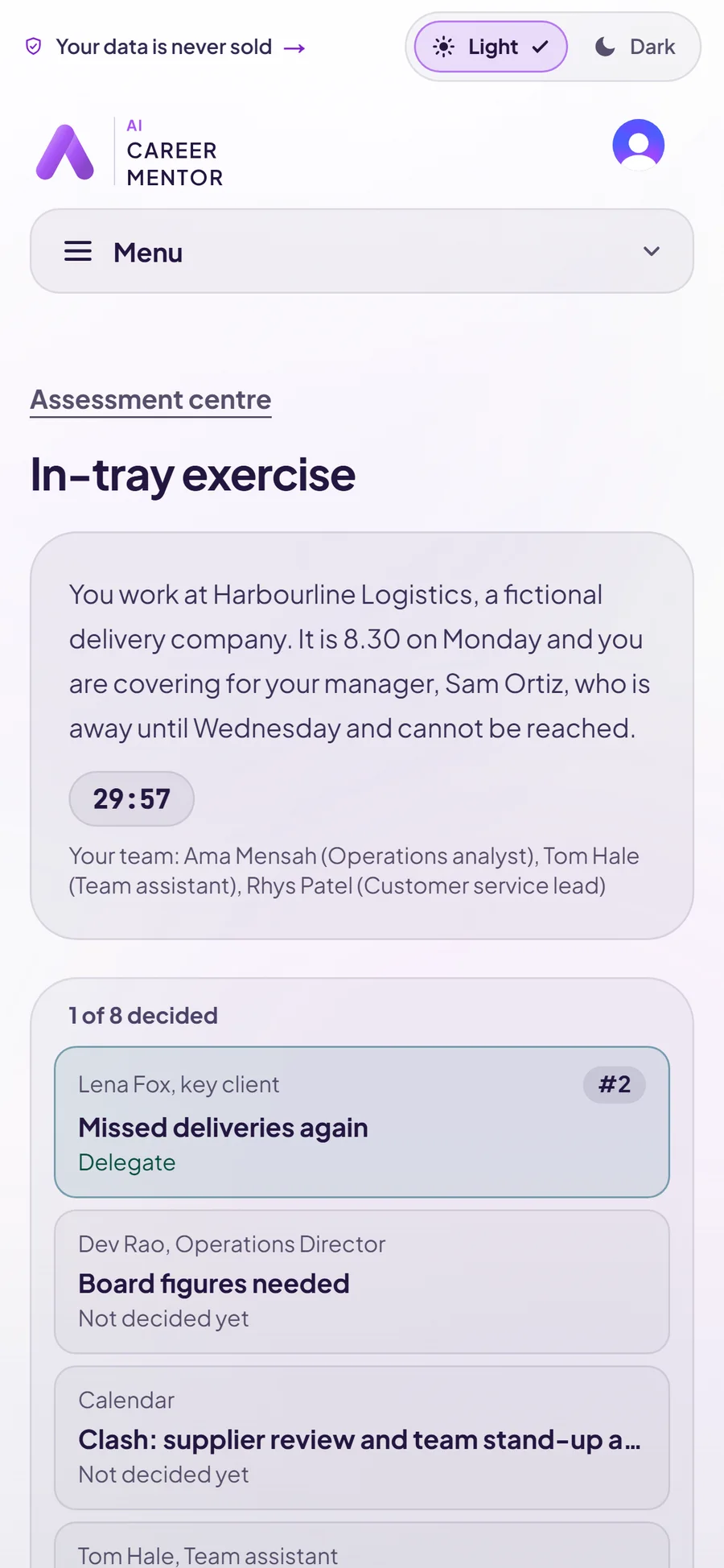
In-tray exercise: the inbox of eight items, one opened with the decision to delegate, its priority and a noteIn-tray exercise: the inbox of eight items, one opened with the decision to delegate, its priority and a note

If you add it: group exercise

Bring the group to a decision

Three other candidates, each backing a different option. Assessors watch how you contribute, not whose idea wins.

  • 18 briefs across career areas
  • Type or speak your contributions
  • Marked on contribution, listening and influence
Group exercise: the candidate and three other candidates discussing which project should get a community grantGroup exercise: the candidate and three other candidates discussing which project should get a community grant

At the end

One report, like an assessor's

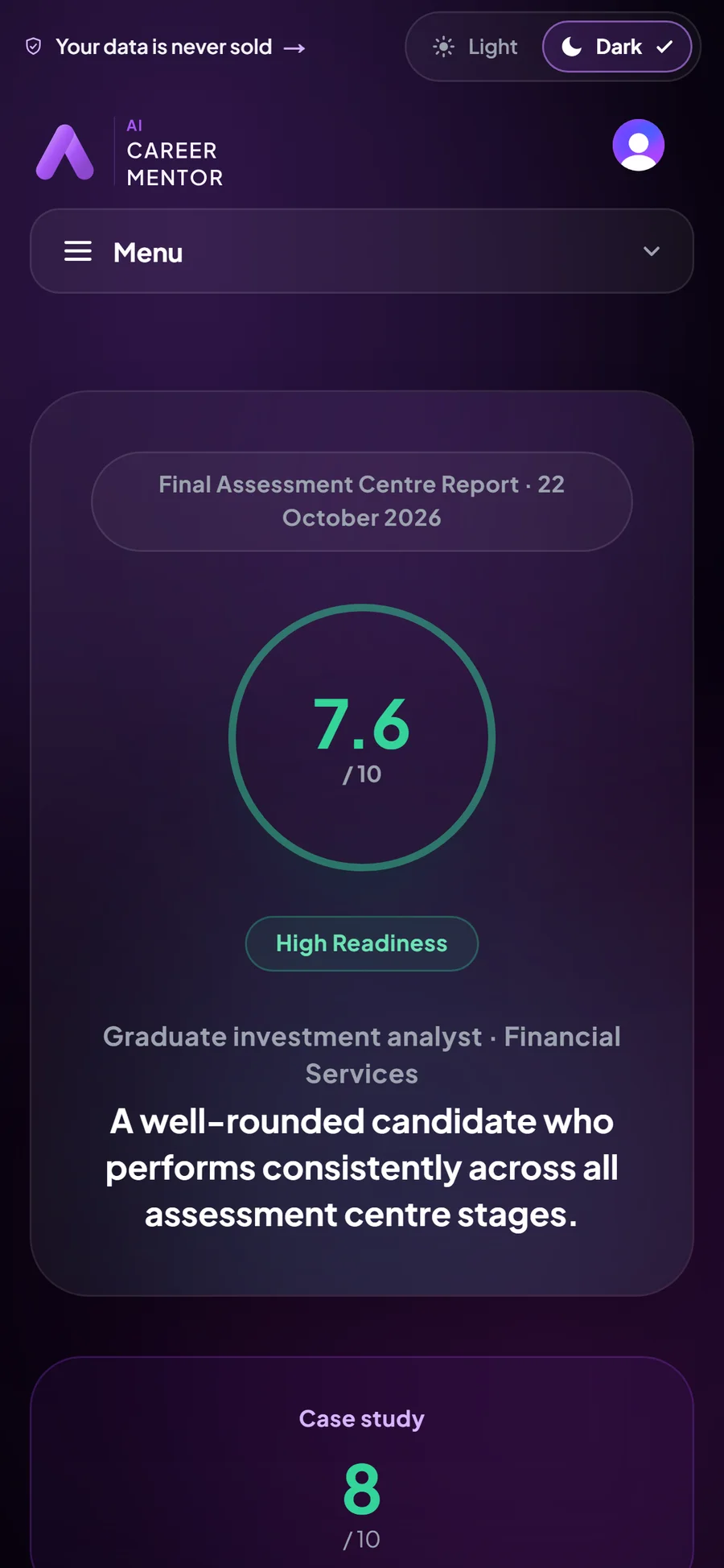
An overall readiness score, a score for every stage, and a breakdown by competency with what to work on.

  • Readiness out of 10, with a one-line verdict
  • A score for each stage you took
  • Every competency scored, with the next step for each
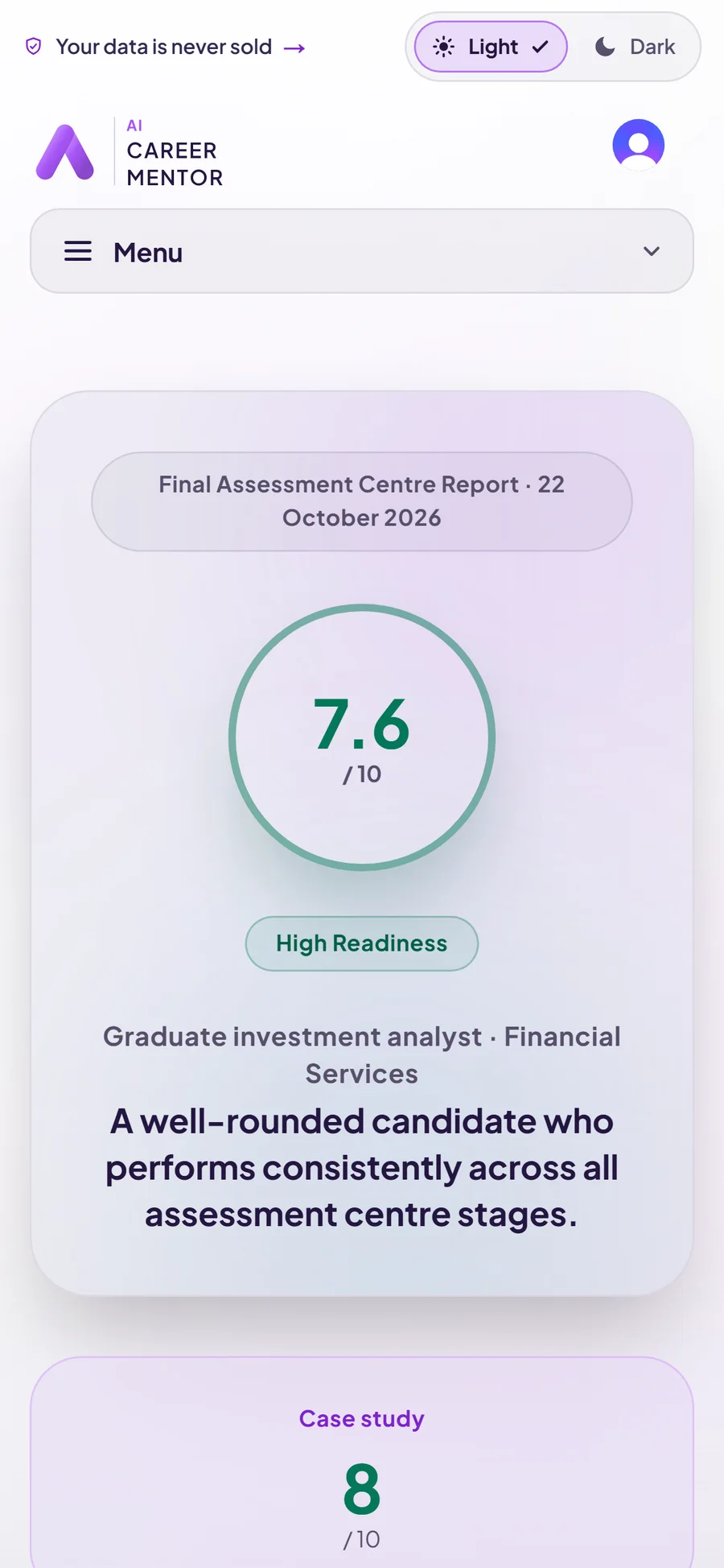
Final assessment centre report: 7.6 out of 10, high readiness, with case study 8, interview 7 and presentation 8Final assessment centre report: 7.6 out of 10, high readiness, with case study 8, interview 7 and presentation 8

Why it matters

Practice that actually mirrors the real thing.

Built like the real thing

Real assessment centres test multiple skills under time pressure. Single-question practice can't simulate that. This can.

Multi-axis scoring report

Get a single rolled-up readiness score plus a per-stage and per-competency breakdown, exactly what an assessor produces.

Run it before the real one

Use it the week before. The pattern of your weaknesses across every stage becomes clear, and you have time to fix them.

Repeat with new scenarios

A different case study, presentation brief and in-tray each time, and a choice of 18 group exercise briefs. Practice does not get stale.

Frequently asked questions

What is a mock assessment centre?+

A structured simulation of an assessment centre: a timed case study, a competency interview and a presentation exercise, with an in-tray and a group exercise you can add, all scored in one session with one final report. It follows the multi-stage structure commonly found in graduate and professional assessment centres across consulting, finance, law and the public sector.

How long does a session take?+

About 40 minutes for the usual three stages: case study analysis (about 12 minutes), a five-question competency interview (about 15 minutes) and a three-minute spoken presentation, plus reading time. Adding the in-tray (30 minutes) and the group exercise (12 minutes) makes it about 80 minutes. You choose the stages when you set it up.

Who uses assessment centres?+

Assessment centres are widely used across consulting, finance, law, the public sector, and competitive graduate programmes. If you are applying to a large employer or a structured graduate scheme, there is a high probability you will face one.

What competencies does it score?+

Your performance is scored across multiple competencies including leadership, analytical thinking, communication, teamwork, and commercial awareness, with specific scores and improvement steps for each.

Is it free?+

It is included in your 3-day free trial, which needs no payment details, so you can run a full centre before deciding. After that it is part of Pro (£15 a month, £38 a quarter or £120 a year), with unlimited runs and fresh scenarios each time.

Can I practise the in-tray or group exercise on its own?+

Yes. Both are on the assessment centre page as stand-alone exercises, so you can work on one without running a whole centre. There are also situational judgement, numerical and verbal reasoning tests in Practice tests, for the online test stage that often comes first.

Walk into your assessment centre fully prepared.

Included in Pro, and in your 3-day free trial. Repeat with new scenarios as often as you need.